
New Research Consortium Report Explains Why PAYERS Must Take the Lead in Changing the Way We Approach and Treat Cancer
Sep 16, 2026
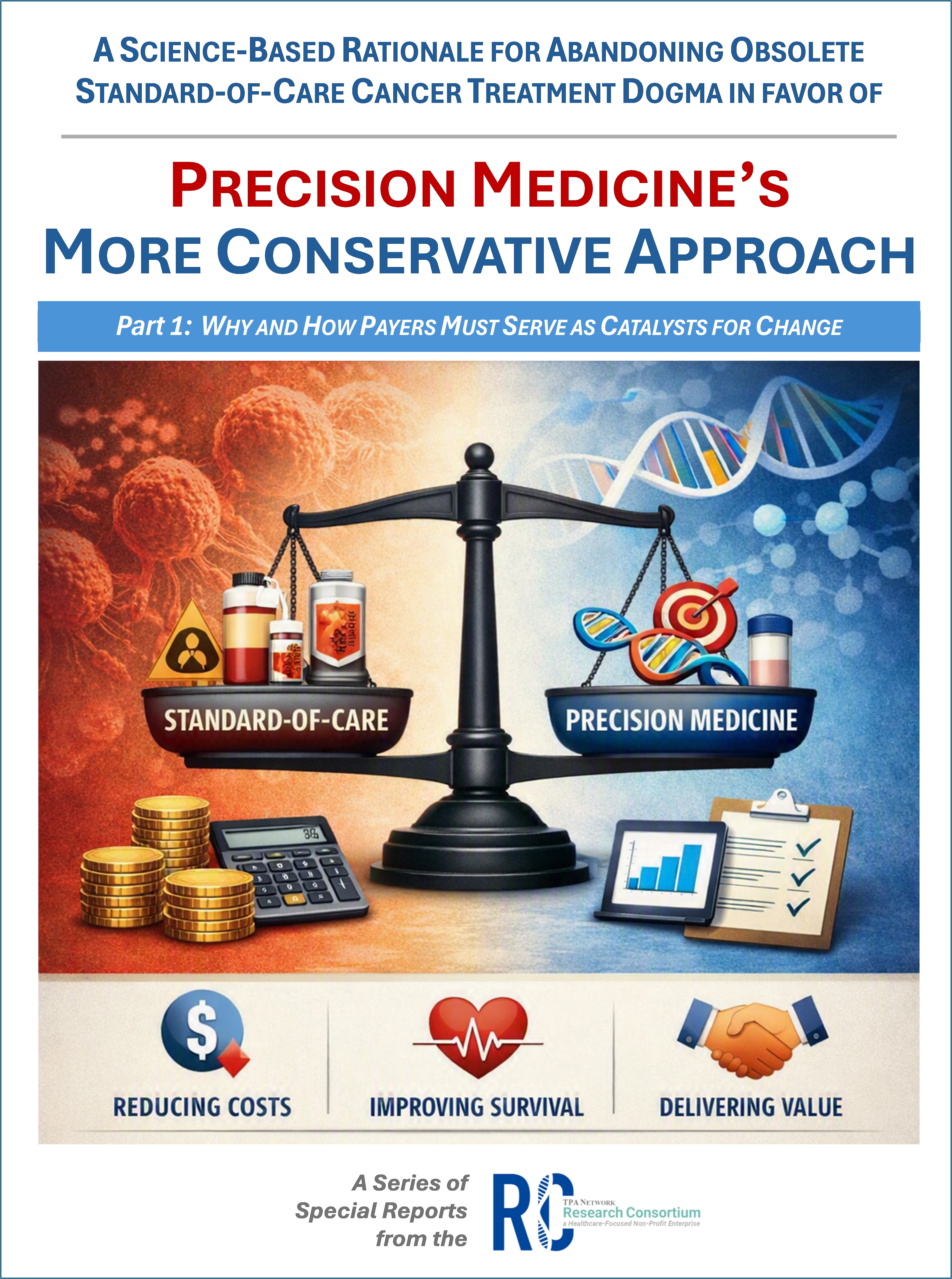
The transition from outdated, one-size-fits-all standard-of-care cancer treatment to science-based personalized care cannot be left to physicians / health systems: it must be led by payers / employer plan sponsors who make critical coverage decisions
San Diego, California Sep 15, 2026 (Issuewire.com) - A new report from the nonprofit TPA Network Research Consortium explains why health insurers must bear much of the responsibility for changing how cancer is approached and treated. The first-in-a-series report details how payers can help drive this change by following the organization's Precision Medicine Protocol, a framework for supporting a more individualized approach to cancer care.
It is possible that as many as 80% of cancer patients in the United States receive suboptimal care, in large part because of the continued reliance on organ-based, one-size-fits-all clinical guidelines that do not adequately account for the variation among individual cancers. When treatment decisions are guided by these generalized approaches rather than by the unique characteristics of each patient's cancer, patients may receive toxic, high-cost regimens that offer limited or no clinical value. Instead, treatment should be more appropriately aligned with the biology of the disease it is intended to treat.
Precision medicine integrates modern genomics into cancer care, substantially deepening our understanding of the disease and transforming how it can be treated. Rather than relying on sameness-based, standard-of-care approaches, it uses each patient's unique molecular profile to guide the selection of therapies that are biologically matched to their cancer. This approach helps identify targeted and potentially effective drugs while eliminating treatments that are unlikely to provide clinical value. By avoiding ineffective therapies, precision medicine can reduce unnecessary toxicity and improve outcomes while containing cost. It is a conservative, more cautious and science-based approach to care -- one that stands in clear contrast to blindly following obsolete, pre-genomic-era treatment dogma.
Research Consortium founder Richard Nicholas, a 48-year healthcare industry veteran, believes that payers continue to perpetuate suboptimal cancer care because they have not made a meaningful commitment to precision medicine. In his view, that commitment is essential to ensuring that cancer treatment decisions better reflect the unique characteristics of each patient's cancer.
"Organ-based cancer treatment must be superseded, as it excuses decision-making based on incomplete knowledge. By contrast, precision medicine's science-based, look-before-you-leap treatment approach is actually a more conservative course of action versus blindly following obsolete pre-genomic era dogma.
"It is high time for payers and health plan sponsors to earnestly embrace precision medicine. To do otherwise would be to continue to deny patients access to vital genomic testing and the option to try potentially viable FDA-approved cancer drugs; essentially permitting continued wasteful spending on high-cost, low-clinical-value drugs" Richard L. Nicholas
Payers' Responsibility to Advance Precision Medicine
Comprehensive health care coverage is a cornerstone of effective cancer care; and coverage decisions shape access, quality, cost, and outcomes throughout the cancer journey, influencing everything from the initiation of treatment through long-term survivorship. When coverage decisions deny, delay, or disrupt access to care, they affect not only the treatment patients receive but also the outcomes they experience. Nicholas believes that because payers make coverage decisions, much of the responsibility for driving the transition to precision medicine rests with them. He reasons that responsibility cannot rest entirely with providers and health systems, which do not control coverage determinations. Payers must therefore earnestly embrace precision medicine and support coverage decisions that advance more effective cancer care, rather than continuing to accept ineffective treatments and wasteful spending on them.
A Practical Framework for Advancing Precision Medicine
To help health insurers and self-funded employers drive meaningful change, the nonprofit Research Consortium created a Precision Medicine Protocol as a practical framework for supporting more effective, individualized cancer care. This report, the first in a series on precision medicine, describes the protocol and explains how and why payers can support its use. It also examines how payers can promote cancer care that is better aligned with individual patient needs while addressing the quality, cost, and value considerations that shape coverage decisions. Later installments in the series will provide additional detail about the protocol, challenge conventional thinking about the cost and value of combination drug treatments and show payers how to gain greater control over oncology specialty-drug spending.
The report is available for download here.
Should you wish to learn more about how you can support our work, please click on this link to our new fundraising campaign, Advancing Personalized Cancer Care. Cancer patients everywhere will be glad you did.
About the TPA Network Research Consortium
The TPA Network Research Consortium is a non-profit, industry-wide healthcare research initiative that helps providers evaluate and assess new medical technologies and innovations, plan participants obtain leading-edge healthcare, scientists advance medical research, and payers reduce risk ... by conducting payer-focused translational research, in real-world settings. Visit ResearchConsortium.org

Media Contact
TPA Network Research Consortium, Ltd.
8583954114
555 Saturn Blvd, Suite B408
Source :TPA NETWORK RESEARCH CONSORTIUM LIMITED
This article was originally published by IssueWire. Read the original article here.
More News

Spanish firm set to buy Harland and Wolff
Spain’s state-owned shipbuilder Navantia is in exclusive talks to buy the Belfast-based shipyard.

Cyber wars and global collaboration: Huawei executive on cybersecurity
"Cybersecurity is no longer a weapon of mass disruption but of mass destruction, because it can kill lives," said Aloysius Cheang, Huawei's president of Cybersecurity & Privacy Protection and chief security officer for the Middle East and Central Asia, stressing the increasingly dangerous nature of cyberattacks.

China's economy shows stable overall performance
China's economy has continued to improve and made steady progress in high-quality development, amidst a complex and ever-evolving international landscape.

China's yuan loans grow by 16.02 trillion yuan in first 3 quarters
China's yuan-denominated loans rose by 16.02 trillion yuan (about $2.27 trillion) in the first three quarters of the year. The M2, a broad measure of money supply that covers cash in circulation and all deposits, climbed 6.8 percent year on year to 309.48 trillion yuan at the end of September.

China to enhance catalytic role of government investment
On September 26, the Political Bureau of the Central Committee of the Communist Party of China convened a meeting to analyze the current economic situation and outline the next steps for economic work. This meeting not only signaled a shift in China's macroeconomic policy but also showed the country's confidence in achieving its annual economic and social development goals, rallying the entire society to drive sustained economic recovery and improvement.

Ensuring rule-based high-quality development of the private sector
A draft law on China's private sector promotion was released to solicit public opinions last week, marking a significant milestone in the construction of a law-based business environment in China.

How Kamala Harris’s Economic Plan Has Been Shaped by Business Leaders
The vice president has repeatedly incorporated suggestions from business executives into her economic agenda.

China’s Stock Markets Rebound on Promises to Help Businesses
Assurances from government officials on plans to strengthen the private sector offset a lack of specifics about economic stimulus.

China reports 5.3% growth in foreign trade over first three quarters
China's foreign trade surged robustly in the first three quarters of 2024, surpassing the 32 trillion yuan ($4.44 trillion) mark for the first time during this period.

‘I lost £165k to fraud in an hour’ - customers say they were let down by Revolut
Revolut was named in more complaints about fraud last year than any of the UK’s biggest banks or e-money services.

TSMC 3rd-quarter profit to jump by 40% amid rising chip demand
TSMC 3rd-quarter profit to jump by 40% amid rising chip demand

John F. Kennedy Jr.’s 1990s-Era Magazine Is Back, With a QAnon Twist
It is a reanimation story strange enough for a zombie movie, made possible by the fact that the original George trademark lapsed, only to be secured by a conservative lawyer.

Evan Gershkovich, U.S. Journalist Imprisoned in Russia, Will Publish a Memoir
The memoir, which will cover his time in prison and Russia’s move toward autocracy, will be published by Crown, an imprint of Penguin Random House.

Dreaming of diamonds: Generations dig for fortune in India's gem town
In Panna, families hunt for diamonds hoping to strike rich and escape the cycle of poverty.

Thousands of cars that crash in US are ending up in Russia
The South Caucasus nation of Georgia has a huge used car market, with many vehicles finding their way over the border.

The Secretive Dynasty That Controls the Boar’s Head Brand
The deli-meat company made its owners fabulously wealthy. But they have remained silent, even as the company faces the biggest scandal in its history.

Watch: Why is the latest SpaceX rocket test a big deal?
The BBC's Pallab Ghosh explores why this world first test is a big deal for space exploration.

Fisher-Price Recalls ‘Snuga Swings’ Linked to Five Infant Deaths
The U.S. Consumer Product Safety Commission announced the recall, which one of its commissioners said was “doomed to fail.”

How Roger Goodell Made the NFL the World’s Wealthiest Sports League
Under the expansionist leadership of its commissioner, the National Football League is growing richer and richer. So, too, is Mr. Goodell.

Pakistan hosting SCO meeting is a turning point for regional diplomacy
Pakistan hosting SCO meeting is a turning point for regional diplomacy

Executives and Research Disagree About Hybrid Work. Why?
Companies like Amazon have required a return to the office five days a week despite findings showing benefits to employers that allow some remote days.

Mortgage costs 'unlikely' to return to low levels
The boss of the UK's biggest lender says mortgage costs are unlikely to fall to levels seen in the past decade.

Budget rule change could mean more money to build hospitals
Here is how the chancellor could choose to tweak the government's borrowing rules to free up more cash.

Port plan to go ahead after row over minister's comments
A £1bn investment will take place, despite a row with the owner of P&O Ferries, says the business secretary.

Why Millennials Prioritize Spending Money to Improve Their Lives
Placing a high value on personal growth, millennials and Gen Z appear more likely than older generations to make hobbies and nonessential purchases a spending priority.

Work Advice: How Can I Get My Male Boss to Notice Me?
When there are men in the room, a female colleague is made to feel invisible.

Filmed in New York, Hold the Taxis and Radiators
When independent movies like “Rosemead” travel to a state for tax incentives, they save money but add creative challenges.

China's consumer prices rose moderately in September
China's consumer prices rose moderately in September. Experts say that market demand is set to rise following the introduction of powerful new policies aimed at stimulating the economy.

California Rejects Bid for More Frequent SpaceX Launches
A commission denied a request to increase the number of rocket launches on the state’s central coast, citing environmental concerns.

Fitch Ratings Issues Warning About France’s Finances
A rating agency’s warning about the country’s ballooning debt comes as the prime minister tries to push an austerity budget through a divided Parliament.

Led by Believers in the City’s Future, Detroit Is on the Rebound
Once the largest city in the U.S. to declare bankruptcy, this Midwestern metropolis is now thriving. But some obstacles still remain.

China stimulus policy blueprint shows passion, patience & perseverance
China's economic policy shift can be viewed through three keywords: passion, patience and perseverance.

P&O owner to attend summit despite row over minister's comments
It had been feared they might pull out after Transport Secretary Louise Haigh criticised the ferry firm and urged consumers to boycott the company.
YOUR NEWS, OUR NETWORK.
Do you have Great News you want to tell the world?
Be it updates about your business or your community, you can make sure that it’s heard by submitting your story to our network reaching hundreds of news sites across 6 verticals.